
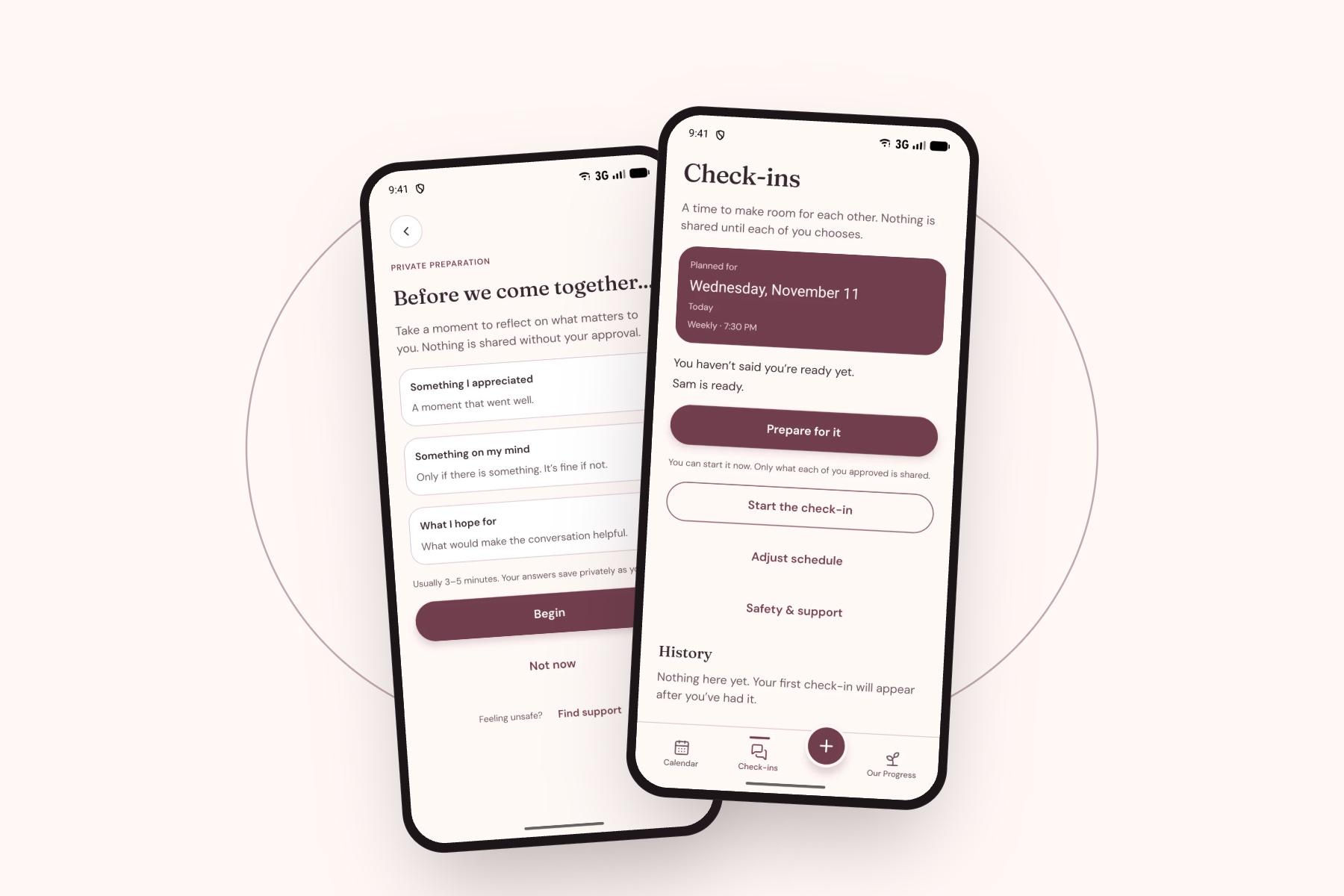
Most couples talk all day: who is picking up groceries, whether the train is late, what to do about the weekend. What gets squeezed out is the slower conversation about how things are actually going between the two of you. A relationship check-in is a simple way to make room for it on purpose, instead of waiting for it to arrive at the end of a long day.
What is a relationship check-in?
A relationship check-in is a short conversation you both agree to have, at a time you both agree on, about the relationship itself. Not the logistics, and not a crisis. Just what has been good lately, what has been on your mind, and what would help. Some people call it a couples check-in; the idea is the same.
Three things make it a check-in rather than an ordinary chat:
It is agreed. Neither of you springs it on the other. You both know it is coming and roughly what it is for.
It has a rhythm. It happens again, so nothing has to be said all at once.
It has a shape. A few familiar questions keep it from drifting into an argument about whatever happened last.
Why a regular rhythm helps
When there is no agreed time to talk, every concern has to find its own moment. That moment is often the worst one: late at night, when both of you are tired, or straight after the thing that hurt. Small worries wait until they are not small any more, and good moments pass without being said at all.
A rhythm changes that. If you know you will sit down together on Sunday evening, a thought on Tuesday can wait without being lost. You can write it down, let it settle, and bring it when you are both ready to listen.
How to do a relationship check-in
There is no single right way to check in with your partner, but these steps keep it calm and short:
Agree on a time. Pick a moment that is not at the end of an exhausting day, and put it in both calendars.
Prepare on your own. Spend five minutes alone with two or three of the questions below. Some couples keep a private relationship journal during the week so the small things are not forgotten.
Start with something good. Each of you names one thing you appreciated. It is easier to talk about the hard things once the good ones have been said out loud.
Take turns. One person speaks while the other listens and tries to repeat back what they heard before replying. The goal is to understand, not to win.
Agree on something small, if it helps. One concrete thing you both say yes to, such as a phone-free dinner this week, and when you will look at how it went.
Stop on time. Twenty or thirty minutes is often plenty. Ending on time keeps a check-in from becoming the long, draining conversation it was meant to replace.
How often should you check in?
A weekly relationship check-in suits many couples: often enough that things stay small, rare enough that it does not feel like a chore. Others prefer every two weeks, or a monthly relationship check-in for the bigger picture, with a few minutes each week in between. Some couples add a two-minute morning check-in on busy days: one thing you are looking forward to, and one thing you might need from each other.
The right rhythm is the one you will both keep. You can change it whenever it stops fitting.
Relationship check-in questions for couples
You do not need all of these. Pick three to five per check-in, and let both of you choose. These couples check-in questions work for a weekly check-in or a longer monthly one.
To start with appreciation
What is one thing I did this week that you appreciated?
When did you feel closest to me lately?
What made you smile this week?
What is something you are proud of us for?
Is there a small kindness from me that you would like more of?
To see how you are both doing
How are you, really, this week?
What has been taking up most of your energy?
Did you feel heard by me this week? When did you not?
Is there anything you have been carrying on your own that I could help with?
How do you feel about how we have been sharing the load at home?
To talk about what is on your mind
Is there something you have been putting off saying?
Was there a moment this week that stayed with you?
What is one thing you would like us to talk about, without solving it tonight?
Is there something I do that you would like me to change, if it is easy?
Is there a worry about us that you would like me to know about?
For needs and support
What would make next week easier for you?
How can I support you with what is coming up?
Do you need more time together, more time alone, or about the same?
What does feeling cared for look like for you right now?
Is there anything you need from me that you have not asked for?
For agreements and follow-through
How did the thing we agreed on last time go for you?
Is it still worth keeping, or should we change it?
What is one small thing we could try this week?
What would help us remember it?
When should we look at how it went?
Monthly relationship check-in questions
What has been the best part of this month for us?
What do you want more of next month, and what less of?
Are we spending our time and money in a way that feels like us?
Is there something we keep coming back to that deserves a longer conversation?
What is one thing you are looking forward to doing together?
A simple relationship check-in template
If you want a structure to follow, this one fits on a single page. Write it down, save it on your phone, or use it as a starting point for your own.
Appreciation (5 minutes). One thing each of you appreciated since last time.
How we are doing (5 to 10 minutes). One or two questions from the lists above, taking turns.
What is on my mind (5 to 10 minutes). One topic each, if you have one. Listen first; solving can wait.
One small agreement (5 minutes). Optional. Something concrete you both say yes to.
Next time. When you will check in again, and anything to look at then.
When it is okay to pause
Some weeks are too full. Someone is ill, work is heavy, or one of you simply does not have it in you. A check-in is something you choose together, so either of you can say "not this week" without it meaning anything more. Pausing and picking up the rhythm again is part of how it works, not a failure of it. If a conversation gets heated, it is fine to stop, take a breath, and come back to it later.
What a check-in is not
A check-in is a conversation between the two of you. It is not a performance review, and there is no score. It does not decide who is right. It is also not therapy. If something feels bigger than a weekly conversation can hold, talking to a qualified counsellor is a good next step, not a sign that check-ins failed. And if you ever feel unsafe with your partner, please reach out to local support services or emergency services rather than trying to talk it through at home.
That is all a relationship check-in is: a small, regular promise to make room for each other. It does not need to be perfect to be worth doing.